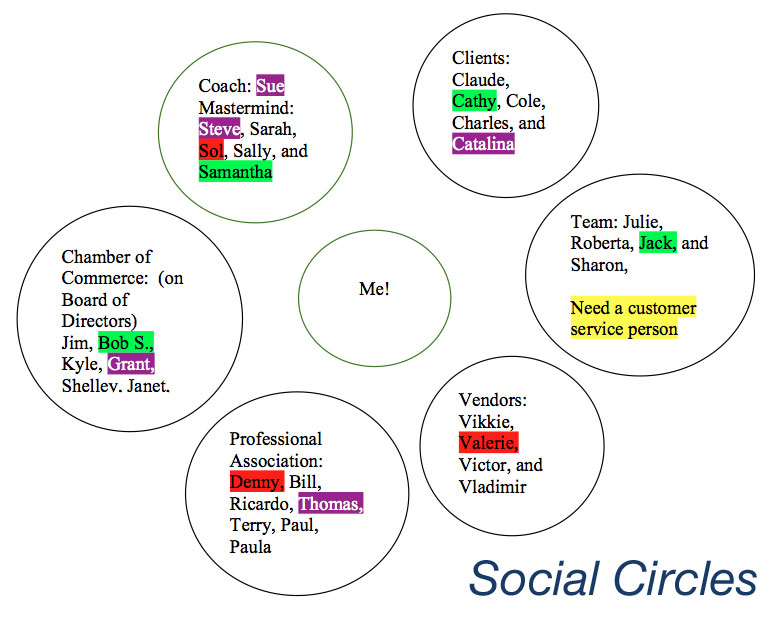
Click above to see enlarged image
Whether we run a large company with dozens of employees or run our own solo business, we rely on a support team of vendors, customers, employees, contractors, and other associates that help us carry out our business goals. Here’s a fun exercise to discover the strengths and weaknesses of your business support team and how you can increase and strengthen the support you have.
Take out a blank sheet of paper, and draw a small circle in the middle. Write your name in the circle. This represents you.
Draw a little larger circle next to your circle. Write your employees’ names and major functions in this circle. Draw a similar circle for contractors’ names and functions. If you have partners and/or affiliates, include them in a big circle.
Draw a small circle for your five largest clients, and write their names in the circles. Draw another small circle for your five largest vendors, and write their names in the circles.
Draw one more circle for your business mentors and coaches, and write their names inside the circle. If you have any more major groups related to your business, draw them now.
These circles represent your business and all of the people you rely on to get your job done.
Now, think about what groups you belong to that relate indirectly to your business. It could be a professional association, a licensing agency, or a networking group. Make large circles for each of the groups you feel connected to, and write some of the key names you know that are part of each of the groups.
Add a few more circles in the same way if you have more business associates to list or other groups that you didn’t add above. If you want to, you can also include your personal support team: the nanny, cook, gardener, esthetician, wardrobe consultant, makeup artist, nail artist, hair stylist, nutritionist, personal workout trainer, butler, chauffeur, masseuse, travel agent, and water boy. Okay, maybe listing the water boy is getting a little carried away.
The sheet should now represent all of the important people in your business that support you in one way or another. It’s a lot, isn’t it?
Now is where the aha’s come in:
- Take a look at your to do list and see if there are holes in your team that you need to fill. Are there job openings or are you ready to bring in more support? Mark the openings or potential openings with a yellow highlighter.
- With a green highlighter, mark the people who are most positive and supportive to you. You may want to let them know how much you appreciate them if it’s been a while.
- With a red highlighter, mark anyone who is costing you more than supporting you. It may be time for a change in team members.
- With a purple highlighter, list the five people you most look up to and can count on for great advice. These people should either have expert advice or be ahead of you in business.
We’ll stop here, but you can continue selecting colors to evaluate the relationship of the people in your circles.
When you take a look at your social circles, what do you notice?
- Where are you fully supported?
- Where could you use more help?
- Where do you need to make some replacements?
- What else do you notice about your business network?
Make a list of action items you can do to strengthen your business support network.
This is a great exercise to allow you to consciously evaluate and improve the ever-important support system in your business. When you have a great team, you can accomplish so much!
 The least expensive way for just about any business to get new business is through referrals. Yet many business owners simply wait for referrals to show up while shelling out big marketing dollars on other channels. One opportunity that many businesses have, then, is to become more proactive about getting referrals. The question is how to do that most effectively, and here are four tips for your consideration.
 Is your revenue increasing or decreasing every year? There are many factors that can cause your revenue to slide, and one of them I’d like to introduce is your opportunity number.
 As our businesses grow and our schedules fill with serving clients, it’s easy to overlook how our personal financial needs might have changed. Here are eight best-practice tips of millionaire business owners and how they personally protect their wealth.
 A colleague of mine recently brought this to my attention. The early snowstorm in the Northeast a few weeks ago reminded her of the city of Yekaterinburg, a large city two hours east of Moscow by air that often sees snow in October all the way through May. The western border of Siberia is a few hundred miles to the east. In Yekaterinburg, there are many small businesses whose owners need to keep their accounting books just like you do. However there are a couple of twists as you might imagine.
 If your accounts receivable balances are edging up and getting older and older each month, then it might be a good time to bring out the aging reports. But what if we looked earlier in the cycle to see what we could do to collect the sales even sooner? Let’s take a look at five potential changes you can consider making that will speed up your cash flow, reduce aging receivables, and possibly reduce lending costs in your business.
 Do your prospects sometimes balk when you quote your prices? Do you feel you’re losing business because your fees are too high? The problem might not be your prices; it might be the way you’re presenting them to potential clients. Many business owners blame a lost sale on price, but only a small percentage of customers are truly price-sensitive and will make a decision based on price alone. That means the majority of the market buys on value, not price, and that’s what we need to move the focus to when we present prices.
 You might have routines and systems to help a new employee settle in, such as payroll forms and training manuals. You might also have some procedures set up for when you start doing business with new vendors, such as asking them for their tax ID paperwork and having them submit invoices to your standards. But what about onboarding new clients? Most entrepreneurs don’t think about systematizing that process.
 Is finding enough time to do everything you need to do one of your top five small business challenges? If so, you’re not alone; just about every entrepreneur lists “time” as a challenge they face today in running their businesses. It’s not uncommon to feel stressed and overwhelmed at everything you need to do.
 Restaurants do it beautifully. “Did you leave any room for dessert or coffee?”

.jpg)